Potassium Carbonate as a Hydroponic pH Up Adjuster: What Growers Need to Know
Maintaining the correct pH in a hydroponic or fertigation system is one of the most critical — and often underestimated — factors in plant nutrition. When pH drifts too low, growers need a reliable, crop-safe way to bring it back up. Two of the most widely used dry pH-up agents are potassium carbonate and potassium hydroxide. This post breaks down how each works, the chemistry behind the label grades, and how to choose the right product for your operation.
Why pH Management Matters in Hydroponics
In a recirculating or run-to-waste hydroponic system, nutrient solution pH directly controls the availability of every element in your feed. Most crops perform best between pH 5.5 and 6.5. Acidic inputs — CO₂ from root respiration, acidic fertilizers, and organic acids — constantly push pH downward, making a reliable pH-up adjuster a daily operational necessity.
The ideal pH-up agent for hydroponics should:
- Raise pH predictably and without overshoot
- Contribute only agronomically beneficial ions (ideally potassium)
- Be fully water soluble
- Be safe to handle and compatible with fertigation equipment
Potassium Carbonate: The Grower-Friendly pH Up
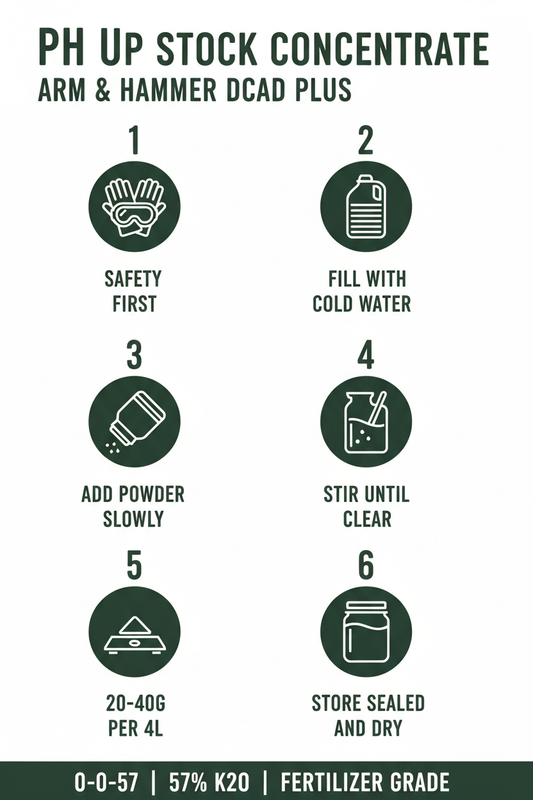
Potassium carbonate (K₂CO₃) is the preferred pH-up agent for most professional hydroponic and fertigation operations. It raises pH through a mild alkaline reaction and simultaneously delivers potassium — a primary macronutrient — directly into the root zone.
Arm & Hammer DCAD Plus – Potassium Carbonate Sesquihydrate (0-0-57)
Our Arm & Hammer DCAD Plus potassium carbonate sesquihydrate (K₂CO₃·1.5H₂O) is a fertilizer-grade, fully water-soluble powder formulated specifically for building pH-up stock concentrates used in fertilizer injection systems. It carries a fertilizer grade of 0-0-57, supplying 57% soluble potash (K₂O) by weight, and is available in four sizes to match any operation:
- 1 lb. — ideal for small-scale growers, trials, and bench testing
- 4 lb. jar — the go-to size for most commercial stock tank preparation
- 20 lb. — suited for mid-size operations with regular pH correction needs
- 50 lb. — bulk pricing for large commercial and greenhouse operations
The Chemistry Behind the Label: Sesquihydrate vs. Anhydrous
Understanding why potassium carbonate products carry different fertilizer grades comes down to one variable: water content.
Sesquihydrate Form (K₂CO₃·1.5H₂O) — 0-0-57
The sesquihydrate includes 1.5 molecules of bound water, which adds mass without adding potassium. The molar mass calculation:
- K: 2 × 39.10 = 78.20 g/mol
- C: 1 × 12.01 = 12.01 g/mol
- O (carbonate): 3 × 16.00 = 48.00 g/mol
- H₂O (×1.5): 1.5 × 18.02 = 27.03 g/mol
- Total: 165.24 g/mol
K₂O equivalence: 94.20 g/mol
Soluble Potash (%) = (94.20 ÷ 165.24) × 100 ≈ 57%
Anhydrous Form (K₂CO₃) — 0-0-68
Removing the bound water significantly increases the potassium concentration. The anhydrous molar mass:
- K: 2 × 39.10 = 78.20 g/mol
- C: 1 × 12.01 = 12.01 g/mol
- O: 3 × 16.00 = 48.00 g/mol
- Total: 138.21 g/mol
Soluble Potash (%) = (94.20 ÷ 138.21) × 100 ≈ 68%
| Form | Chemical Formula | Fertilizer Grade |
|---|---|---|
| Sesquihydrate | K₂CO₃·1.5H₂O | 0-0-57 |
| Anhydrous | K₂CO₃ | 0-0-68 |
The 11-point difference in potash grade is entirely due to the "dead weight" of the water molecules in the sesquihydrate form. Both forms deliver the same potassium per mole — the anhydrous version simply delivers more potassium per pound of product purchased.
Potassium Hydroxide: The High-Strength Alternative
For operations that require more aggressive pH correction or need to build highly concentrated stock solutions, potassium hydroxide (KOH) — also known as caustic potash — is the go-to choice.
OxyChem Potassium Hydroxide Flake – Caustic Potash (0-0-75)
Our OxyChem Potassium Hydroxide Flake is a high-purity caustic potash with a minimum of 90% KOH, produced via a non-mercury cell process. It meets ANSI/AWWA B511-10, USP/NF, and FCC test requirements — making it suitable for food-grade and regulated production environments. It carries a fertilizer grade of 0-0-75, the highest potassium concentration of any common dry pH-up agent, and is available in four sizes:
- 1 lb. — for small-scale use, lab work, or first-time users evaluating KOH
- 4 lb. — a practical size for regular stock solution preparation
- 20 lb. — for mid-size operations with frequent high-pH correction needs
- 50 lb. bag — bulk commercial supply for large-scale fertigation systems
KOH is significantly more caustic than potassium carbonate. It reacts rapidly and exothermically with water, making it highly effective for pH correction but requiring strict safety protocols. Hazardous material — CORROSIVE (UN1813, Class 8, PGII).
Potassium Carbonate vs. Potassium Hydroxide: Which Should You Use?
| Property | K₂CO₃ (Sesquihydrate) | KOH Flake |
|---|---|---|
| Fertilizer Grade | 0-0-57 | 0-0-75 |
| Available Sizes | 1, 4, 20, 50 lb. | 1, 4, 20, 50 lb. |
| pH Raising Strength | Moderate | Strong |
| Reaction Speed | Gradual | Rapid / Exothermic |
| Hazard Level | Low (PPE recommended) | High (CORROSIVE, Hazmat) |
| Best Use Case | Stock concentrates, precision dosing | High-concentration stock solutions |
For most commercial hydroponic and fertigation operations, potassium carbonate is the preferred starting point. Its moderate alkalinity makes it easier to dose accurately, it contributes beneficial potassium without the hazmat handling requirements of KOH, and it is compatible with most injection systems. Potassium hydroxide is best reserved for operations that need maximum pH-raising power per pound or are building very high-concentration stock tanks where the lower volume of KOH is operationally advantageous.
Application Tips
- Always add powder to water — never water to powder — to control the dissolution reaction.
- Use cold water when dissolving potassium carbonate to minimize heat generation.
- Wear PPE — gloves and eye protection at minimum; full face shield for KOH.
- Prepare stock concentrates rather than dosing dry product directly into the reservoir.
- Titrate slowly — add pH-up in small increments and allow the system to equilibrate before re-testing.
- Account for potassium contribution in your nutrient balance, especially at high pH-correction volumes.
- Right-size your purchase — start with 1 or 4 lb. to dial in your dosing rates before committing to 20 or 50 lb. bulk quantities.
Shop pH Up Adjusters
Custom Hydro carries both potassium carbonate and potassium hydroxide in professional grades for hydroponic and fertigation applications. Both products are available in 1, 4, 20, and 50 lb. sizes — whether you need a small jar for bench trials or a 50 lb. bulk bag for a large commercial greenhouse, we have the right size for your system.