EDTA in the Environment: Setting the Record Straight on Agriculture's Role
EDTA has a persistence problem — not just in the environment, but in the conversation around it. The chelating agent shows up in wastewater monitoring studies, river sediment analyses, and environmental impact assessments, and agriculture reliably gets a share of the blame. That attribution isn't entirely wrong. But it's significantly incomplete, and the incomplete version does a disservice to growers who are making responsible, agronomically sound decisions about micronutrient management.
This article looks at where EDTA actually comes from, what the science says about its environmental behavior, and how agricultural use fits into a much larger picture dominated by industrial chemistry, household detergents, and personal care products.
What EDTA Is and Why It Persists
EDTA (ethylenediaminetetraacetic acid) is a synthetic aminopolycarboxylic acid with an exceptional ability to bind metal ions. It forms stable, water-soluble complexes with calcium, magnesium, iron, zinc, copper, manganese, and other metals — a property that makes it useful across an enormous range of applications, from industrial descaling to food preservation to micronutrient fertilization.
The same stability that makes EDTA useful also makes it persistent. Unlike many organic compounds, EDTA resists biodegradation under typical environmental conditions. It is not readily broken down by soil microbes, it passes through conventional wastewater treatment largely intact, and it can mobilize heavy metals bound in sediments by forming soluble complexes with them.1 These are legitimate environmental concerns, and they deserve honest discussion.
What they don't deserve is selective attribution.
Where EDTA Actually Comes From
Global EDTA production is estimated at several hundred thousand metric tons per year. The breakdown of end uses tells a clear story about where environmental loading originates.
Industrial and cleaning applications account for the largest share of EDTA use globally. Pulp and paper manufacturing uses EDTA to control metal-catalyzed bleaching reactions. Textile processing uses it to sequester calcium and magnesium that would otherwise interfere with dyeing. Industrial descaling and boiler water treatment rely on EDTA to dissolve mineral scale. Electroplating and metal finishing use it as a complexing agent. These are high-volume, continuous industrial processes that discharge EDTA-containing effluent at scale.2
Household detergents and cleaning products represent another major source. EDTA has been used as a builder in laundry detergents to soften water by sequestering calcium and magnesium, improving surfactant performance. Conventional wastewater treatment removes EDTA poorly — removal rates in standard activated sludge systems are typically below 20% — meaning the bulk of what goes down the drain reaches surface water.1,2
Personal care and cosmetic products use EDTA (typically as disodium EDTA or tetrasodium EDTA) as a preservative and stability agent. It appears in shampoos, conditioners, lotions, liquid soaps, and a wide range of rinse-off products. Like detergents, these products enter wastewater streams continuously and at high volume across the entire consumer population.
Food processing and preservation uses EDTA as an approved additive to prevent oxidative discoloration and rancidity in canned goods, salad dressings, and other processed foods. EDTA consumed in food is excreted largely intact and enters wastewater through that route as well.
Agricultural fertilization is a real but comparatively minor contributor to environmental EDTA loading. Chelated micronutrient fertilizers are applied at agronomic rates measured in ounces to pounds per acre. In soil, EDTA-chelated nutrients are taken up by plants or, over time, the chelate degrades through photolysis and slow microbial activity. Runoff from agricultural fields does contribute EDTA to surface water, but the volumes involved are a fraction of what enters waterways from industrial and municipal sources.2,3
What the Research Actually Shows
Studies of EDTA in European rivers — where the compound has been monitored since the 1980s — consistently identify municipal wastewater effluent as the dominant source. Kari and Giger's landmark analysis of Swiss river systems found that industrial and municipal wastewater accounted for the overwhelming majority of EDTA loading, with agricultural runoff representing a secondary diffuse source.2 Similar findings have been reported across Dutch, German, and UK waterways.
The photodegradation pathway is relevant context for agricultural use specifically. EDTA exposed to UV light — as it would be in surface irrigation water, shallow soil, or open water bodies — degrades significantly faster than EDTA in shaded or subsurface environments.3 Agricultural EDTA, applied to soil and plant surfaces in relatively small quantities, has substantially more UV exposure than EDTA discharged in industrial effluent or passing through shaded municipal pipe systems.
Bucheli-Witschel and Egli's comprehensive review of EDTA biodegradation pathways confirmed that while EDTA is recalcitrant under most environmental conditions, photolytic degradation in sunlit surface waters is a meaningful removal pathway — one that disproportionately benefits the agricultural use case relative to industrial discharge.1
This doesn't make agricultural EDTA environmentally neutral. It means the risk profile is meaningfully different from industrial sources, and that conflating the two produces a distorted picture of where mitigation efforts should be focused.
The Alternatives and Their Trade-offs
The environmental discussion around EDTA in agriculture often leads to recommendations for alternative chelating agents — DTPA, EDDHA, and amino acid chelates — as more biodegradable options. This is partially accurate and worth understanding clearly.
DTPA is somewhat more biodegradable than EDTA under aerobic soil conditions but still persists in anaerobic environments and passes through wastewater treatment at rates similar to EDTA. EDDHA is more stable than EDTA across a wider pH range — which is agronomically useful — but its environmental persistence is comparable or greater. Amino acid chelates are genuinely more biodegradable and represent the most environmentally favorable option where they are agronomically appropriate, particularly for foliar applications.1
The practical reality is that chelate selection in agriculture is driven primarily by system pH, crop requirements, and cost — and EDTA remains the most appropriate and cost-effective choice for the majority of hydroponic and soilless systems operating below pH 6.5. Recommending that growers switch to more expensive alternatives primarily to address an environmental problem dominated by non-agricultural sources is a misallocation of concern.
Where growers can make a meaningful difference is in application precision: applying chelated micronutrients at agronomic rates based on tissue testing and water analysis, avoiding over-application, and managing runoff from open systems. These are good agronomic practices regardless of the environmental calculus.
EDTA Products in Agricultural Use
For context, here are the EDTA-chelated micronutrient products used in professional horticulture and hydroponics, and the agronomic role each plays:
- Iron EDTA: Sequestar 13.2% Fe EDTA — primary iron source for hydroponic systems operating at pH 5.5–6.5
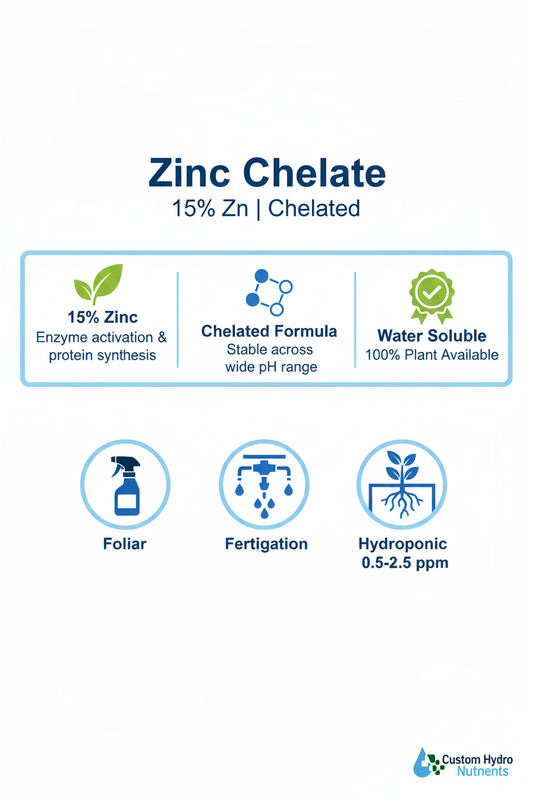
- Zinc EDTA: Zinc EDTA 15% Zn (1 lb, 4 lb, 20 lb), Lidoquest Zinc EDTA 55 lb, Brandt Sequestar 14% Zinc EDTA microgranule
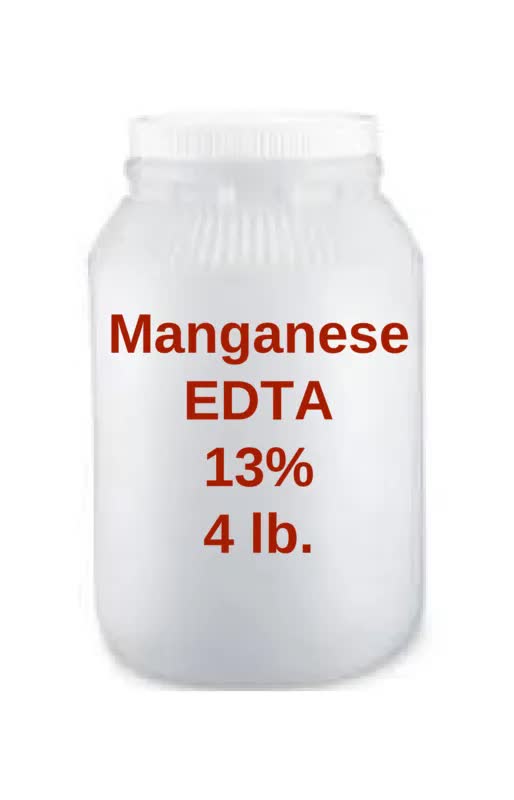
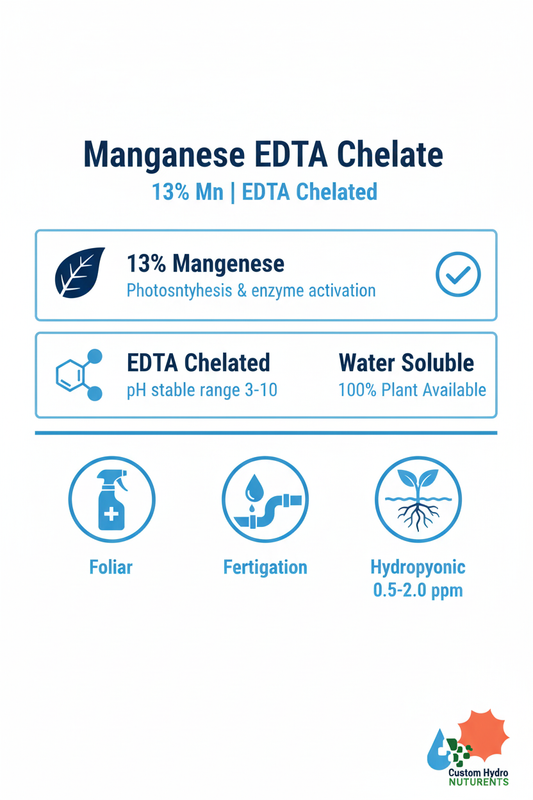
- Manganese EDTA: Manganese EDTA 13% Mn (1 lb, 4 lb, 20 lb)
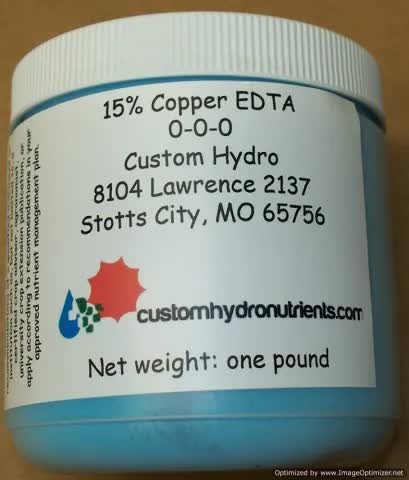
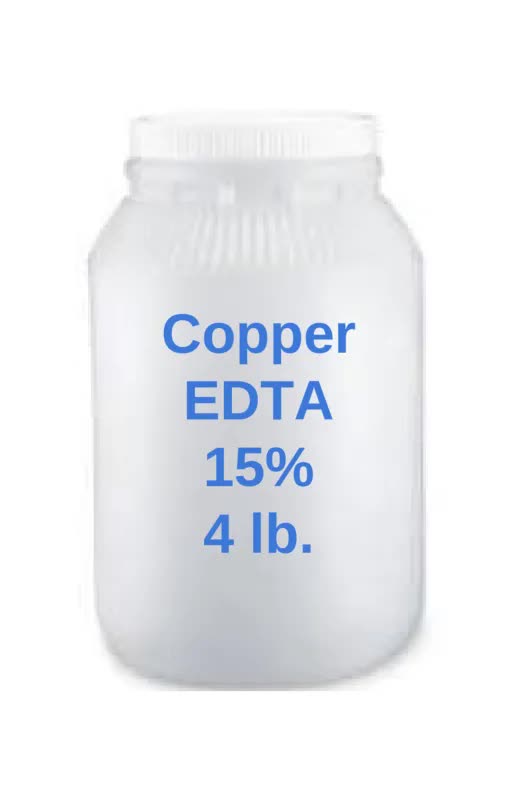
- Copper EDTA: Copper EDTA 15% Cu (1 lb, 4 lb, 20 lb)
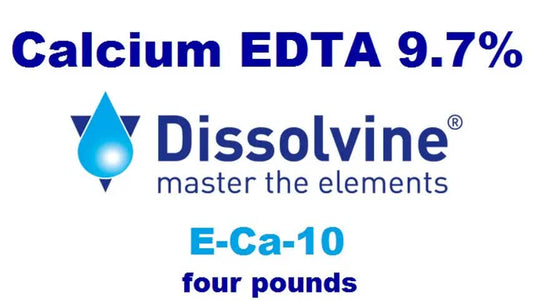
- Calcium EDTA: Calcium EDTA 9.7% (1 lb, 4 lb, 20 lb), REXOLIN Calcium EDTA 55 lb
- Magnesium EDTA: Magnesium EDTA 6% (1 lb, 4 lb)
These products are applied at rates typically ranging from a few grams to a few ounces per 100 gallons of nutrient solution, or at similarly small per-acre rates in fertigation programs. The quantities involved are orders of magnitude smaller than industrial EDTA use.
The Honest Position
Agriculture uses EDTA. That use contributes, in a small way, to environmental EDTA loading. Growers should apply chelated micronutrients at appropriate rates, avoid over-application, and consider biodegradable alternatives like amino acid chelates where they are agronomically and economically viable.
But the framing that positions agricultural EDTA as a primary environmental concern misrepresents the source distribution of the problem. The dominant contributors are industrial manufacturing, household cleaning products, and personal care formulations — high-volume, continuous sources that discharge EDTA through wastewater systems with minimal treatment removal.
Growers making precision micronutrient decisions based on water analysis and tissue testing are not the problem. They are, in fact, the model for how any input — including EDTA — should be used: at the right rate, for the right reason, in the right system.
If you have questions about chelate selection for your system or want to explore amino acid alternatives for specific applications, contact us and we'll help you find the right fit.
References
The following foundational studies underpin the claims in this article. We recommend supplementing with a Google Scholar search for post-2020 literature on “EDTA environmental persistence wastewater” before citing this article in formal contexts.
- Bucheli-Witschel, M., & Egli, T. (2001). Environmental fate and microbial degradation of aminopolycarboxylic acids. FEMS Microbiology Reviews, 25(1), 69–106. — The canonical review of EDTA persistence, biodegradation pathways, and photolytic degradation in surface waters. Covers comparative persistence of EDTA, DTPA, and EDDHA.
- Kari, F. G., & Giger, W. (1996). Speciation and fate of ethylenediaminetetraacetate (EDTA) in municipal wastewater treatment. Water Research, 30(1), 122–134. — Key source attribution study for EDTA in Swiss river systems; identifies industrial and municipal wastewater as dominant sources.
- Means, J. L., Kucak, T., & Crerar, D. A. (1980). Relative degradation rates of NTA, EDTA and DTPA and environmental implications. Environmental Pollution Series B, Chemical and Physical, 1(1), 45–60. — Foundational study on comparative degradation rates of synthetic chelating agents, including photolytic pathways relevant to agricultural surface applications.