Microalgae and Soil Biology: The Science Behind Sigma MICROALGAE
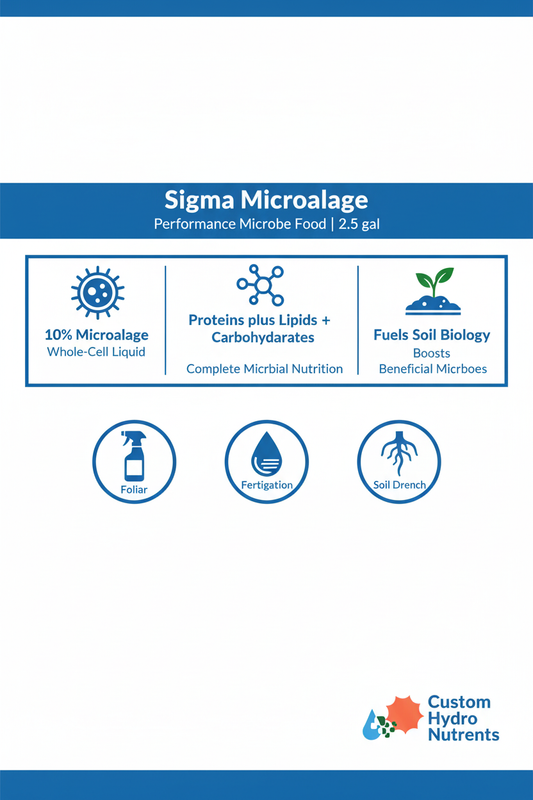
Healthy soil isn't just dirt — it's a living ecosystem teeming with bacteria, fungi, actinomycetes, and microalgae that work in concert to cycle nutrients, build organic matter, and protect plants from disease. At Custom Hydro, we're always looking for inputs that work with this biology rather than against it. That's why we're excited to introduce Sigma MICROALGAE Performance Microbe Food — a whole-cell pasteurized liquid microalgae product designed to fuel your soil's microbial engine.
Why Soil Microbiology Matters
Microbial communities are the foundation of long-term soil fertility. These microorganisms are responsible for breaking down organic matter, sequestering carbon, and transforming nutrients through processes like oxidation, nitrification, and nitrogen fixation. Without a thriving microbial population, even the best fertilizer program will underperform.
The challenge is that conventional chemical inputs — fungicides, synthetic fertilizers, and pesticides — can disrupt or suppress these communities over time. Biological inputs like microalgae offer a different path: feeding and amplifying the biology that's already there.
How Microalgae Stimulate Soil Biology
Microalgae don't just add nutrients — they actively reshape the microbial landscape of your soil through several interconnected mechanisms:
1. Feeding the Microbial Food Web
Through their metabolic activity, microalgae produce extracellular polysaccharides (EPS), organic acids, and bioactive compounds that enrich microbial habitats. These carbon-rich exudates serve as a direct food source for bacteria and fungi, stimulating population growth and activity at the root zone.
Sigma MICROALGAE delivers a dense nutritional payload per 2.5-gallon jug:
- Proteins (24 g/L) — essential for building and repairing microbial cells
- Lipids (21 g/L) — structural components of microbial cell membranes, supporting resilience under stress
- Carbohydrates (44 g/L) — the primary energy source fueling microbial metabolism
2. Synergistic Microalgae–Bacteria Consortia
One of the most compelling aspects of microalgae biology is the synergistic relationship they form with soil bacteria. Microalgae release dissolved organic carbon and oxygen into their surrounding microenvironment, stimulating bacterial processes like nitrogen fixation, nitrification, and organic matter decomposition. In return, associated nitrogen-fixing and phosphate-solubilizing bacteria release nutrients — including nitrogen, phosphorus, and CO₂ — that support overall soil fertility.
Research has demonstrated this effect clearly: the combined use of cyanobacteria (N. linckia) and A. lipoferum increased total soil nitrogen by 20.7–40% and nitrate plus nitrite nitrogen by 27.1–59.2% compared to uninoculated soils. That's a meaningful fertility boost driven entirely by biological activity.
3. Shifting Microbial Communities Toward Beneficial Populations
Microalgae-based inputs don't just feed existing microbes — they actively shift the composition of the microbial community. Studies show that microalgae applications increase populations of beneficial bacteria and fungi such as Thermonaerobaculia, Microascaceae, and Sordariomycetes, while simultaneously suppressing plant pathogens including Pseudomonas, Togniniaceae, and Phaeoacremonium.
This shift is driven by multiple mechanisms: the EPS and easily degradable organic carbon produced by microalgae promote saprophytic and symbiotic organisms, while phytohormones and antimicrobial compounds produced during application inhibit pathogen proliferation. The result is a more disease-resistant, biologically diverse rhizosphere.
4. Supporting Soil Biodiversity and Resilience
Soil biodiversity is a critical measure of soil health — and microalgae are uniquely positioned to support it. By feeding a diverse array of microbial groups, microalgae foster functional redundancy: the ability of the soil ecosystem to maintain critical processes like nutrient cycling and disease suppression even under environmental stress. This is particularly relevant for specialty crop and vegetable growers managing high-intensity production cycles where soil biology can be easily depleted.
Application in Soil and Coco Systems
Sigma MICROALGAE is approved for organic production and integrates seamlessly with existing fertilizer programs. It's best suited for soil and organic systems where a living rhizosphere is present. Key application notes:
- Apply at planting (soil or bare root), then repeat every 2–4 weeks
- Agitate thoroughly before use — full suspension is essential
- Apply in early morning or late afternoon when temperatures are below 85°F (30°C)
- Do not combine with fungicides, insecticides, or chemical fertilizers — allow 6–7 days before or after chemical fungicide applications
For crops and broadacre: mix 1 pint to 1 gallon per acre in a minimum of 5 gallons of finished solution. For turfgrass: 64–128 oz per acre per application.
The Bottom Line
Sigma MICROALGAE is not a fertilizer in the traditional sense — it's a biological catalyst. By delivering a concentrated, whole-cell microalgae substrate directly to the root zone, it fuels the microbial populations that drive nutrient cycling, organic matter decomposition, and disease suppression. For growers committed to living soil and long-term soil health, it's a powerful addition to any biological program.
Shop Sigma MICROALGAE Performance Microbe Food — 2.5 gallons →