Nitrogen Form and pH: Choosing the Right Nitrogen Source for Soilless and Hydroponic Systems
Nitrogen is the nutrient growers think about most and understand least. Not the quantity — most experienced growers have their N rates dialed in — but the form. Nitrate, ammonium, and urea behave differently in solution, interact differently with plant roots, and have measurable, predictable effects on the pH of your nutrient solution and root zone. In soilless and hydroponic systems, where there's no soil buffer to absorb these shifts, nitrogen form is a pH management tool as much as it is a fertility input.
This article covers the practical differences between nitrogen forms, how each affects solution and media pH, and which products to use for different system types and crop goals.
The Three Forms of Nitrogen
Commercial fertilizers deliver nitrogen in three chemical forms, each with distinct behavior in solution and at the root surface.
Nitrate nitrogen (NO₃⁻) is the dominant nitrogen form in professional hydroponic and soilless programs. Plants absorb nitrate as a negatively charged anion. When a root takes up NO₃⁻, it releases a hydroxyl ion (OH⁻) or bicarbonate (HCO₃⁻) into the root zone to maintain electrical balance. This OH⁻ release raises pH — nitrate uptake is inherently alkalinizing. In a well-managed hydroponic system, this is a predictable, controllable effect. Nitrate is also immediately plant-available, stable in solution, and compatible with all common hydroponic system types including recirculating systems.
Ammonium nitrogen (NH₄⁺) is absorbed as a positively charged cation. When a root takes up NH₄⁺, it releases a hydrogen ion (H⁺) to maintain charge balance. This H⁺ release acidifies the root zone — ammonium uptake is inherently acidifying. Small amounts of ammonium in a nitrate-dominant program can be used strategically to counteract pH rise, but excess ammonium in soilless systems causes root zone acidification, ammonium toxicity, and suppression of calcium and magnesium uptake through cation competition. In recirculating hydroponic systems, ammonium accumulation is a serious risk.
Urea nitrogen (CO(NH₂)₂) is an organic nitrogen form that must be converted to ammonium by the enzyme urease before plants can use it. In soil, this conversion happens rapidly via soil microbes. In soilless and hydroponic systems, urease activity is minimal — urea conversion is slow and unreliable, and unconverted urea is not plant-available. Urea-based fertilizers are generally not recommended for recirculating hydroponic systems for this reason. They can be used in open fertigation systems where some soil microbial activity is present, but nitrate and ammonium sources are more predictable and reliable for soilless production.
How Nitrogen Form Affects Solution pH
In soilless and hydroponic systems, pH drift is one of the most common day-to-day management challenges. Understanding the nitrogen-pH relationship gives you a lever to manage that drift proactively rather than reactively.
Nitrate-dominant programs cause pH to rise over time. As plants preferentially take up NO₃⁻ and release OH⁻, solution pH climbs. This is the standard pattern in most hydroponic systems — pH rises between reservoir changes or acid additions, and growers correct downward with phosphoric or nitric acid. The rate of pH rise depends on crop uptake rate, nitrogen concentration, and the ratio of nitrate to other anions in solution.
Ammonium inclusion slows or reverses pH rise. A small proportion of ammonium nitrogen — typically 5–15% of total N — in a nitrate-dominant program counteracts the alkalinizing effect of nitrate uptake. This is the principle behind the ammonium content in standard calcium nitrate (15.5-0-0), which contains approximately 1.1% ammonium nitrogen alongside 14.4% nitrate nitrogen. The ammonium fraction helps moderate pH drift without introducing enough NH₄⁺ to cause toxicity or cation competition.
High ammonium programs acidify aggressively. Ammonium sulfate (21-0-0) and monoammonium phosphate (MAP 12-61-0) drop pH rapidly in soilless systems due to their high ammonium content. This can be useful for correcting alkaline media, acidifying high-pH substrate, or supplying phosphorus with a pH-lowering effect in specific crop stages — but both require careful monitoring. In recirculating systems, ammonium accumulation between reservoir changes can cause pH to crash and create toxicity conditions. Use these products in open or substrate systems where pH can be managed through leaching, not in closed recirculating programs.
The practical takeaway: your nitrogen source selection is a pH management decision. Nitrate-dominant programs require more acid additions to manage upward pH drift. Programs with a moderate ammonium fraction reduce acid consumption and moderate pH swings. The right balance depends on your system type, water alkalinity, and crop.
Ammonium-Free Calcium Nitrate: When and Why
Standard calcium nitrate (15.5-0-0) contains a small ammonium fraction — typically around 1.1% NH₄⁺-N. For most crops and systems, this is beneficial. But there are specific situations where even this small ammonium fraction is undesirable:
- Low-temperature growing environments. At temperatures below 60°F (15°C), nitrification — the microbial conversion of ammonium to nitrate — slows significantly. In soilless media with some microbial activity, ammonium can accumulate rather than convert, increasing toxicity risk. Ammonium-free calcium nitrate eliminates this risk entirely.
- Crops sensitive to ammonium toxicity. Some crops — including lettuce, strawberries, and certain herbs — are particularly sensitive to elevated ammonium levels. Tip burn in lettuce, for example, is exacerbated by high ammonium, which competes with calcium for uptake and impairs calcium translocation to rapidly growing tissue.
- Recirculating systems with long reservoir intervals. In systems where nutrient solution is recirculated for extended periods without replacement, ammonium can accumulate as plants selectively take up nitrate. Starting with ammonium-free calcium nitrate eliminates one source of ammonium accumulation.
- High-precision programs. When you need exact control over the NH₄⁺:NO₃⁻ ratio — for research, tissue culture, or specialty crop programs — ammonium-free calcium nitrate gives you a clean nitrate-only calcium source to build from.
Ammonium-free calcium nitrate products available:
- PureCal 13-0-0 Ammonium-Free Calcium Nitrate — available in 1 lb, 4 lb, 20 lb, 40 lb, and 55 lb sizes
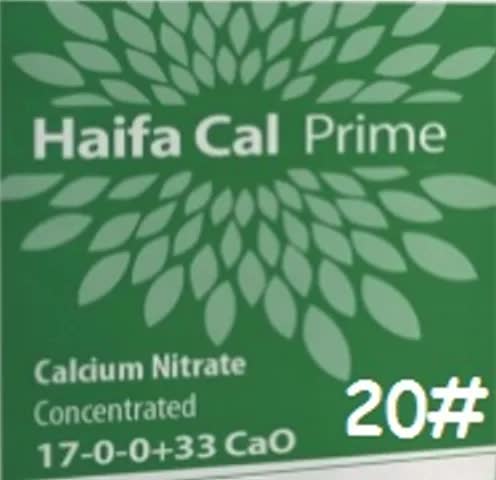
- Haifa Cal Prime 17-0-0 — high-purity, ammonium-free calcium nitrate with elevated calcium content; available in 1 lb, 4 lb, 20 lb, 44 lb, and 55 lb sizes
Nitrogen Sources by Role in a Hydroponic Program
In a complete hydroponic nutrient program, nitrogen comes from multiple sources simultaneously — each contributing N while also supplying a secondary nutrient or serving a specific pH management function.
Calcium nitrate is the primary nitrogen and calcium source in most hydroponic programs. It supplies nitrate-N and calcium in a single, highly soluble product. Standard calcium nitrate (15.5-0-0) contains a small ammonium fraction; ammonium-free grades give pure nitrate-N with calcium.
- Standard: Calcium Nitrate 15.5-0-0 (1 lb, 20 lb, 40 lb), YaraLiva CalciNit 50 lb, Haifa Cal GG 50 lb
- High-purity ammonium-free: Haifa Cal Prime 17-0-0 (55 lb.) — elevated calcium content, zero ammonium
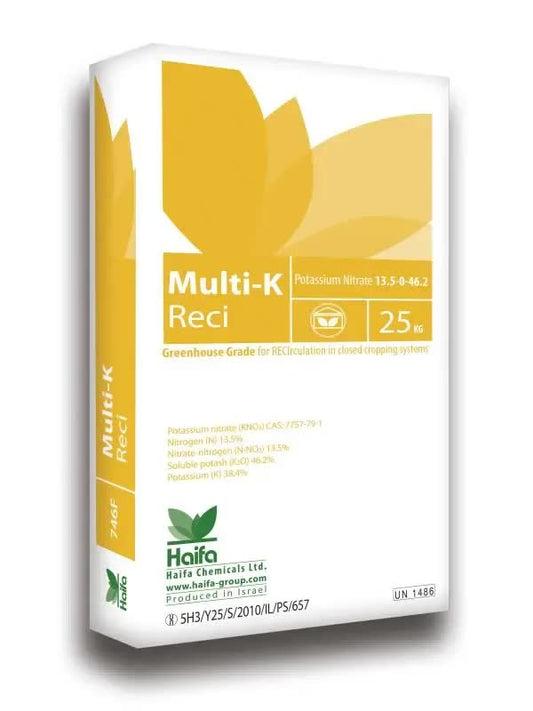
Potassium nitrate supplies nitrate-N and potassium — the standard potassium source in most hydroponic base programs. It's chloride-free, highly soluble, and contributes to the nitrate pool without adding calcium or other cations.
- Potassium Nitrate (1 lb, 4 lb, 20 lb, 50 lb bucket)
- Haifa Multi-K GG (55 lb.) — greenhouse grade, low chloride, excellent solubility
- Haifa Multi-K RECI (55 lb.) — formulated specifically for recirculating systems, ultra-low chloride and sodium
- UltraSol K Plus (50 lb.) — SQM premium potassium nitrate
Magnesium nitrate supplies nitrate-N and magnesium — useful when magnesium sulfate (Epsom salt) would add more sulfate than desired, or when a nitrate-form magnesium source is needed to avoid sulfate accumulation in recirculating systems.
- Magnesium Nitrate (1 lb, 4 lb, 17.5 lb)
- Haifa Magnisal 11-0-0 (50 lb.)
- MAGNIFIC 11-0-0 (55 lb.)
Ammonium sulfate and monoammonium phosphate are high-ammonium nitrogen sources used for targeted pH management and phosphorus delivery in open and substrate systems.
- SoluGreen Ammonium Sulfate 21-0-0 (50 lb.) — water-soluble grade, used for pH correction in alkaline substrate and as a nitrogen source where acidification is desired
- Haifa MAP 12-61-0 (50 lb.) — monoammonium phosphate, high-phosphorus source with acidifying ammonium-N; useful for early-stage programs and pH management in substrate systems
Practical pH Management by System Type
Recirculating hydroponic systems (NFT, DWC, ebb and flow). Use nitrate-dominant programs with minimal or zero ammonium. pH will trend upward between acid additions — this is normal and manageable. Avoid high-ammonium inputs such as ammonium sulfate or MAP entirely. For crops sensitive to ammonium or in low-temperature environments, use ammonium-free calcium nitrate. Use Multi-K RECI potassium nitrate and magnesium nitrate rather than sulfate-form magnesium to minimize anion accumulation over long reservoir cycles.
Open drip / substrate systems (rockwool, coco, perlite). Nitrate-dominant programs work well. A moderate ammonium fraction (5–10% of total N) can help manage pH rise, particularly with alkaline source water. Standard calcium nitrate is appropriate for most crops. Ammonium sulfate or MAP can be used in small quantities to correct alkaline substrate pH or deliver phosphorus with a pH-lowering effect. Monitor leachate pH and EC regularly — substrate systems can develop localized pH gradients that don't show up in the feed solution.
High-alkalinity source water. Alkaline water with high bicarbonate (HCO₃⁻) content pushes pH upward independent of nitrogen form. Acid injection to neutralize bicarbonate is the primary tool, but a slightly higher ammonium fraction in the nitrogen program can reduce acid consumption. Nitric acid (HNO₃) is the preferred acidification choice in hydroponic systems because it adds nitrate-N rather than phosphate or sulfate — it acidifies and fertilizes simultaneously.
Low-temperature environments. Below 60°F, minimize ammonium inputs and use ammonium-free calcium nitrate as your primary calcium-nitrogen source. Cold root zones impair ammonium metabolism and increase toxicity risk even at concentrations that would be safe at normal temperatures.
The Bottom Line
Nitrogen form is not a background variable — it's an active management lever in soilless and hydroponic systems. Nitrate-dominant programs are the standard for good reason: nitrate is stable, immediately available, and predictably alkalinizing in a way that's easy to manage with acid additions. Ammonium has a role as a pH moderator in small quantities but becomes a liability in excess, especially in recirculating systems and cold environments.
The practical rules: use nitrate as your primary nitrogen source, match your calcium nitrate grade to your crop and system temperature, use potassium nitrate and magnesium nitrate to complete your base program, and reserve ammonium inputs — sulfate or phosphate form — for open and substrate systems where targeted pH correction is needed.
Questions about building a nitrogen program for your specific system and water chemistry? Contact us with your water analysis and we'll help you put together a starting point.