Iron Chelate for Hydroponics and Fertigation: EDTA, DTPA, EDDHA, and Amino Acid Compared
Iron deficiency is the most common micronutrient problem in commercial hydroponic and fertigation systems. The symptoms are familiar: interveinal chlorosis on young leaves, pale yellow-green new growth, reduced vigor. The fix seems straightforward — add iron. But which iron, at what rate, and in what form determines whether the application actually works.
Iron chelate is not a single product. It's a category with four distinct chemistries, each with a different stability profile, effective pH range, cost structure, and application method. Choosing the wrong one for your system means the iron you're paying for never reaches the plant.
This article covers every iron chelate type in depth — how each works, when to use it, what it costs per gram of actual iron, and which products to reach for in each scenario.
Why Iron Is Uniquely Difficult in Hydroponic Systems
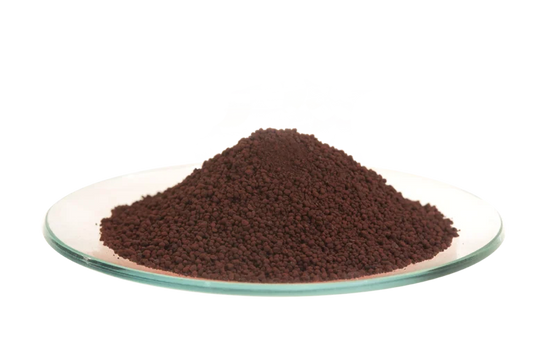
Iron exists in two oxidation states in solution: Fe²⁺ (ferrous, reduced) and Fe³⁺ (ferric, oxidized). Plants primarily absorb iron as Fe²⁺, but iron in solution rapidly oxidizes to Fe³⁺, which precipitates as iron hydroxide — the reddish-brown sludge familiar to anyone who has run an unchelated iron source through a hydroponic system.
Chelation solves this by binding Fe³⁺ in a stable, soluble complex that resists precipitation. The chelate holds iron in solution until the plant root can access it, at which point root-zone chemistry triggers release and reduction to Fe²⁺ for uptake.
The complication: the stability of that chelate-iron bond is highly pH-dependent. At low pH, most chelates hold iron effectively. As pH rises, the bond weakens, competing ions displace iron from the chelate, and precipitation occurs. The pH threshold at which this happens varies dramatically by chelate type — and this is the central variable in iron chelate selection.
The Four Iron Chelate Types
EDTA-Chelated Iron
Effective pH range: 4.0–6.5
EDTA (ethylenediaminetetraacetic acid) is the most widely used and most cost-effective iron chelate. At pH 5.5–6.0 — the sweet spot for most hydroponic crops — EDTA-chelated iron is fully stable, highly soluble, and readily available to plants. It's the right default choice for the majority of NFT, DWC, and drip hydroponic systems operating in this range.
Above pH 6.5, EDTA-iron stability drops sharply. Calcium and magnesium ions begin to compete for the EDTA ligand, displacing iron and causing precipitation. This is why iron deficiency symptoms often appear in systems where pH has crept above 6.5 even when iron is being dosed correctly — the iron is there, but it's no longer chelated and available.
Products:
- Sequestar 13.2% Fe EDTA — premium microgranule, exceptional solubility, ideal for stock tank preparation and precision dosing
Cost efficiency: EDTA-iron is the lowest cost-per-gram-of-Fe option in the chelate category, making it the economical choice for maintenance dosing in systems where pH is well-controlled below 6.5.
Best for: NFT lettuce, herbs, leafy greens, DWC systems, any operation maintaining pH 5.5–6.2 consistently.
DTPA-Chelated Iron
Effective pH range: 4.0–7.5
DTPA (diethylenetriaminepentaacetic acid) is a stronger chelating agent than EDTA, with a five-coordinate binding structure that holds iron more tightly across a wider pH range. DTPA-chelated iron remains stable and plant-available up to pH 7.5, making it the preferred choice for operations running at higher pH or those with variable pH control.
For tomatoes, cucumbers, peppers, and other fruiting crops that perform well at pH 6.0–6.8, DTPA is the more reliable iron source than EDTA. It's also the better choice for fertigation programs where pH fluctuates between irrigation events, or where alkaline source water pushes pH upward between acid injection cycles.
DTPA is typically 30–60% more expensive than EDTA per gram of iron, but the cost premium is justified when pH conditions would compromise EDTA performance. Using EDTA in a pH 6.8 system to save money is false economy — the iron precipitates and the crop pays the price.
Products:
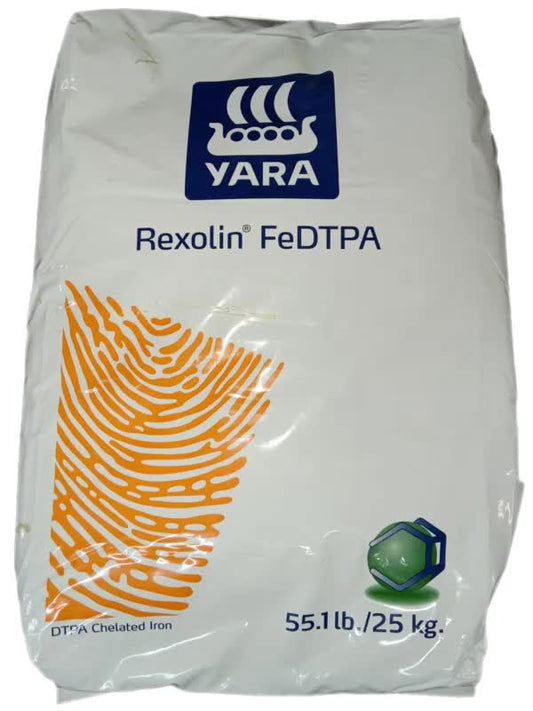
- Sprint 330 — 10% Fe DTPA (5 lb.) — Sprint 330 has been discontinued by the manufacturer. We continue to carry it while supplies last. Rexolin 11% Fe DTPA and Brandt Sequestar 11% Fe DTPA are direct replacements with equivalent performance.
- 10% Fe DTPA (1 lb.) and 10% Fe DTPA (4 lb.) — flexible sizing for smaller operations
- Rexolin 11% Fe DTPA (55 lb.) — bulk commercial sizing, best cost-per-gram for high-volume DTPA users
- Brandt Sequestar 11% Fe DTPA (25 lb.) — mid-scale bulk option from a trusted brand
- Haifa Micro Iron DTPA 11% — potassium salt formulation (vs. sodium salt in most other DTPA products); microgranule for clean dissolution in stock tanks, preferred where sodium load is a concern
Best for: Tomatoes, cucumbers, peppers, strawberries, specialty crop, any system operating at pH 6.2–7.0, operations with variable pH control or alkaline source water.
EDDHA-Chelated Iron
Effective pH range: 4.0–10.0
EDDHA (ethylenediamine-N,N'-bis(2-hydroxyphenylacetic acid)) is the most powerful synthetic iron chelate available. Its ortho-ortho isomer forms an exceptionally stable six-coordinate complex with Fe³⁺ that remains intact across the full agronomic pH range — from strongly acidic to strongly alkaline conditions where every other chelate fails.
EDDHA is the iron chelate of last resort for high-pH systems, calcareous growing media, and persistent iron deficiency that doesn't respond to EDTA or DTPA. It's also the standard iron source for soil-based production in alkaline regions and for operations where pH cannot be adequately controlled.
EDDHA is significantly more expensive than EDTA or DTPA — typically 3–5x the cost per gram of iron. It's not a maintenance product; it's a corrective tool and a solution for specific system constraints. One important note: EDDHA imparts a characteristic reddish-orange color to nutrient solution, which is normal and not an indication of precipitation or contamination.
When evaluating EDDHA products, look for the ortho-ortho (o,o) isomer percentage on the label. The o,o isomer is the active chelating fraction — higher o,o content means more effective iron per gram of product. Products with low o,o content are less effective per unit of stated iron concentration.
Products:
- Sequestar 6% Fe EDDHA — premium EDDHA with high o,o isomer content, excellent for high-pH correction and the recommended replacement for Sprint 138
- Sprint 138 — 6% Fe EDDHA (5 lb.) — Sprint 138 has been discontinued by the manufacturer. We continue to carry it while supplies last. Sequestar 6% Fe EDDHA is the recommended replacement, offering comparable o,o isomer content and performance.
- Iron EDDHA 6% (1 lb.) and Iron EDDHA 6% (4 lb.) — flexible sizing for corrective applications
Best for: High-pH systems (pH 7.0+), calcareous growing media, persistent iron deficiency unresponsive to EDTA or DTPA, operations with limited pH control, alkaline well water.
Amino Acid-Chelated Iron
Effective pH range: broad, absorption pathway-independent
Amino acid chelates represent a fundamentally different approach to iron delivery. Rather than synthetic ligands, iron is complexed with amino acids derived from hydrolyzed proteins. The resulting molecule is absorbed through peptide transport channels in the root and leaf epidermis — a pathway that bypasses the pH-dependent reduction step required for inorganic iron uptake.
This makes amino acid-chelated iron uniquely effective for foliar applications, where rapid absorption through leaf cuticle and stomata is the goal. In acute iron deficiency, foliar amino acid iron can correct visible symptoms within days — faster than any root-zone application can achieve, regardless of chelate type.
Amino acid chelates are also fully biodegradable, OMRI-listed for organic production, and compatible with biological programs where synthetic chelating agents may interfere with microbial activity.
The trade-off is cost — amino acid chelates are the most expensive iron source per gram of Fe — and concentration, as amino acid iron products typically contain lower elemental iron percentages than synthetic chelates. They are best used as a targeted corrective tool rather than a primary iron source for reservoir or fertigation programs.
Products:
- Metalosate Iron Organic (5 lb.) — amino acid-chelated iron for foliar and fertigation, OMRI-listed
- Metalosate Iron Organic (44 lb.) — commercial bulk sizing for operations using amino acid iron at scale
Best for: Foliar correction of acute iron deficiency, organic production programs, situations where rapid symptom correction is needed, biological growing systems.
Side-by-Side Comparison
| Chelate Type | Effective pH Range | Relative Cost | Best Application | Organic Compatible |
|---|---|---|---|---|
| EDTA | 4.0–6.5 | $ | Reservoir / fertigation | No |
| DTPA | 4.0–7.5 | $$ | Reservoir / fertigation | No |
| EDDHA | 4.0–10.0 | $$$ | Reservoir / corrective | No |
| Amino Acid | Broad | $$$$ | Foliar / organic | Yes (OMRI) |
Diagnosing Iron Deficiency vs. Iron Lockout
Before switching chelate types or increasing iron rates, it's worth distinguishing between true iron deficiency and iron lockout — they present identically but have different causes and solutions.
True iron deficiency occurs when the nutrient solution contains insufficient iron. Check your iron dose against your target ppm and verify your stock solution preparation. If iron concentration is correct, the problem is lockout, not deficiency.
Iron lockout occurs when iron is present in solution but unavailable to the plant. The most common causes:
- pH too high: The most common cause. Check pH at the root zone, not just the reservoir — localized pH elevation at the root surface can cause lockout even when reservoir pH appears correct. If pH is above your chelate's effective range, switch to a more stable chelate type before increasing iron rates.
- Phosphorus antagonism: Excess phosphate precipitates iron as iron phosphate. If your P levels are very high, reduce phosphate before increasing iron.
- Manganese excess: High manganese competes with iron for uptake. Check Mn levels if iron deficiency persists despite correct pH and iron concentration.
- Dissolved oxygen deficiency: Root zone hypoxia impairs iron reduction and uptake. Check DO levels and aeration in recirculating systems.
The diagnostic sequence: check pH first, then iron concentration, then antagonists. Most persistent iron deficiency in well-managed systems is a pH problem, not an iron supply problem.
Application Rates and Timing
Iron is typically maintained at 1–3 ppm Fe in hydroponic nutrient solutions for most crops, with higher rates (3–5 ppm) for iron-demanding crops or during periods of rapid vegetative growth. These targets apply regardless of chelate type — the chelate determines availability, not the target concentration.
For corrective applications in response to visible deficiency:
- Reservoir correction: Increase iron to 3–5 ppm and verify pH is within your chelate's effective range. Allow 5–7 days for new growth to show recovery before adjusting further.
- Foliar correction: Apply amino acid-chelated iron at label rate to affected foliage during early morning. Repeat every 3–5 days until new growth shows normal color. Continue root-zone iron to prevent recurrence.
- EDDHA for persistent deficiency: Apply at 10–20% of your normal iron rate alongside your standard chelate program. EDDHA's superior stability will supply iron in the pH range where your primary chelate is failing.
Choosing the Right Product for Your Operation
The decision tree is straightforward once you know your system pH and sodium sensitivity:
- pH consistently below 6.5: EDTA iron is your most cost-effective option. No reason to pay the DTPA premium.
- pH 6.2–7.0, standard fertigation or open systems: DTPA iron is the right call. At commercial scale, Rexolin 55 lb. or Brandt Sequestar 25 lb. are the go-to replacements now that Sprint 330 has been discontinued.
- pH 6.2–7.0, recirculating hydroponics or sodium-sensitive applications: Haifa Micro Iron DTPA 11% is the preferred choice. As a potassium salt formulation, it avoids the sodium load introduced by standard sodium-salt DTPA products — an important consideration in closed recirculating systems where sodium accumulates over time.
- pH above 7.0, persistent deficiency, or calcareous media: Sequestar EDDHA is the recommended option following the discontinuation of Sprint 138.
- Acute foliar correction or organic program: Metalosate Iron for targeted foliar application. The 44 lb. size for operations using it regularly at scale.
If you're unsure which product fits your system, send us your water analysis and target pH and we'll give you a straight recommendation.