Hydroponic Lettuce Nutrient Solutions: Practical Feeding for DWC, NFT, and Raft Systems
Lettuce is the gateway crop for most hydroponic operations — fast-cycling, space-efficient, and highly responsive to dialed-in nutrition. But “forgiving” doesn’t mean “low-maintenance.” Tip burn, bolting, and stunted heads are almost always nutrition or environment problems in disguise. This guide covers the full feeding program for water culture (DWC, NFT, raft) and soil systems, grounded in Eurofins Agro research data for Lactuca sativa.
Why Lettuce Nutrition Is Different
Lettuce is a light feeder compared to fruiting crops. It has a short cycle (30–60 days depending on variety and system), lower potassium demand relative to tomatoes, and a strong sensitivity to ammoniacal nitrogen — too much NH₄ causes tip burn and root issues. The ideal lettuce solution is moderate EC, nitrate-dominant nitrogen, and well-balanced calcium. Iron demand, however, is surprisingly high — the Eurofins water culture target of 40 µmol/L Fe (2.240 ppm) exceeds tomato targets and reflects lettuce’s rapid vegetative growth rate.
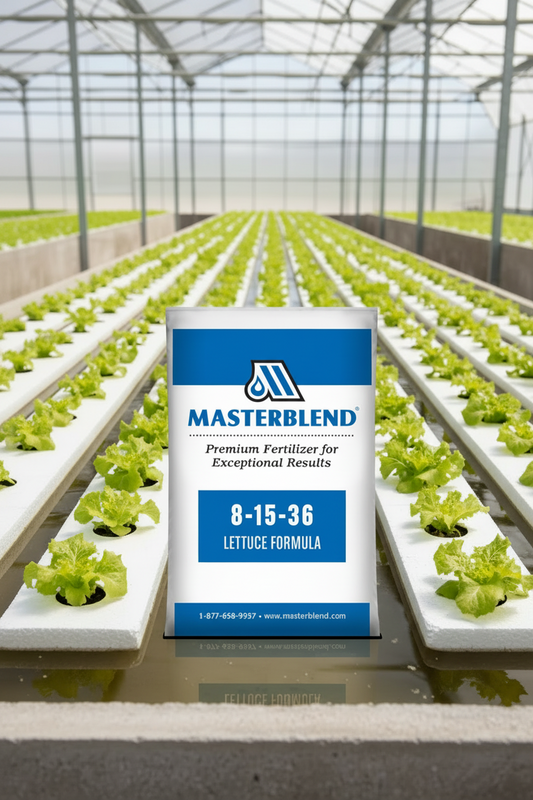
The MasterBlend Lettuce Formula
The MasterBlend 8-15-36 Lettuce Formula is purpose-built for leafy greens. The higher nitrogen ratio (8N vs. 4N in the tomato formula) supports rapid vegetative growth without pushing excessive salt stress.
Standard lettuce recipe (per gallon):
- MasterBlend 8-15-36: 2.4 g
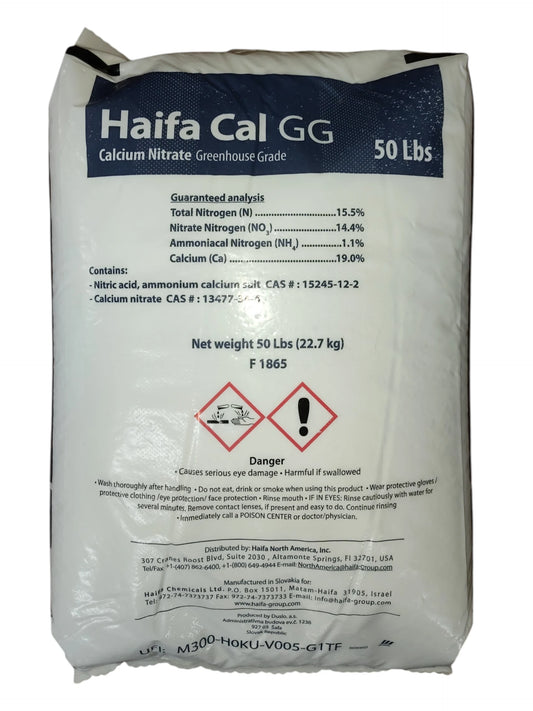
- Calcium Nitrate (YaraLiva CalciNit 15.5-0-0): 2.4 g
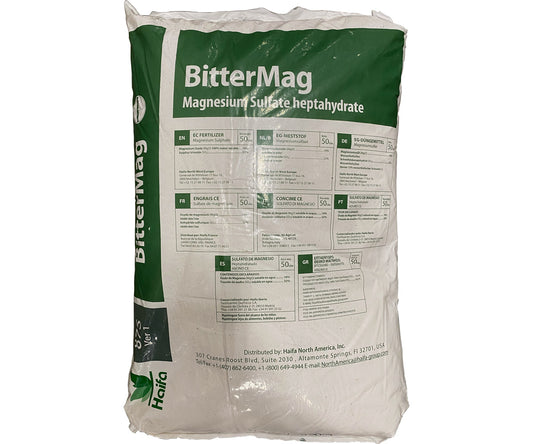
- Magnesium Sulfate: 1.2 g
This delivers a baseline EC of approximately 1.2–1.6 mS/cm — right in the lettuce sweet spot for most water culture systems.
Nutrient Targets: Water Culture (DWC, NFT, Raft)
Eurofins Agro publishes two EC tiers for lettuce in water/aqua systems — a standard tier and a high-EC tier used for larger heads or premium production. All mmol/L values include mg/L (ppm) equivalents for growers using ppm meters. Micronutrient values are expressed in ppm throughout.
| Parameter | Unit | Standard — Target | Standard — Target (ppm) | Standard — Solution | Standard — Solution (ppm) | High EC — Target (ppm) | High EC — Solution (ppm) |
|---|---|---|---|---|---|---|---|
| pH | — | 5.5 | — | 5.3 | — | — | — |
| EC | mS/cm | 2.5 | — | 2.2 | — | 4.0 | 2.6 |
| N-NH₄ | mmol/L | <0.5 | <7.0 | 1.0 | 14.0 | <2.0 | 14.0 |
| K | mmol/L | 6.0 | 235 | 9.5 | 371 | 235 | 371 |
| Ca | mmol/L | 6.0 | 240 | 4.5 | 180 | 240 | 180 |
| Mg | mmol/L | 2.0 | 49 | 1.0 | 24 | 49 | 24 |
| N-NO₃ | mmol/L | 14 | 196 | 16 | 224 | 196 | 224 |
| S | mmol/L | 2.0 | 64 | 2.0 | 64 | 64 | 64 |
| P | mmol/L | 2.0 | 62 | 1.5 | 47 | 62 | 47 |
| Fe | µmol/L | 40 | 2.240 | 40 | 2.240 | 2.240 | 2.240 |
| Mn | µmol/L | 8 | 0.440 | 7 | 0.385 | 0.440 | 0.385 |
| Zn | µmol/L | 8 | 0.523 | 7 | 0.458 | 0.523 | 0.458 |
| B | µmol/L | 50 | 0.540 | 40 | 0.432 | 0.540 | 0.432 |
| Cu | µmol/L | 1.5 | 0.095 | 1.0 | 0.064 | 0.095 | 0.064 |
| Mo | µmol/L | 1.5 | 0.144 | 1.0 | 0.096 | 0.144 | 0.098 |
| Na | mmol/L | <6.0 | <138 | — | — | <138 | — |
| Cl | mmol/L | <6.0 | <213 | — | — | <213 | — |
| HCO₃ | mmol/L | <0.5 | <30 | — | — | <6.0 | — |
Source: Eurofins Agro crop nutrition guidelines for Lettuce (Lactuca sativa) — Water/Aqua systems. All ppm values = mg/L on the weight/volume scale. Micronutrient ppm values calculated from µmol/L using elemental atomic weights.
Nutrient Targets: Soil Systems
Soil-grown lettuce operates at significantly lower EC and simpler nutrition. Eurofins Agro differentiates by headweight target (<300g vs >300g) and season (Summer vs Winter). All values include ppm equivalents.
| Parameter | Unit | <300g Summer | ppm | <300g Winter | ppm | >300g Summer | ppm | >300g Winter | ppm |
|---|---|---|---|---|---|---|---|---|---|
| pH* | — | 6 | — | 6 | — | 6 | — | 6 | — |
| EC | mS/cm | 1.0 | — | 1.2 | — | 1.2 | — | 1.4 | — |
| N-NH₄ | mmol/L | <0.1 | <1.4 | <0.1 | <1.4 | <0.1 | <1.4 | <0.1 | <1.4 |
| K | mmol/L | 2.5 | 98 | 3.0 | 117 | 3.0 | 117 | 3.5 | 137 |
| Ca | mmol/L | 3.25 | 130 | 3.25 | 130 | 3.25 | 130 | 3.25 | 130 |
| Mg | mmol/L | 1.0 | 24 | 1.0 | 24 | 1.0 | 24 | 1.0 | 24 |
| N-NO₃ | mmol/L | 4.0 | 56 | 5.0 | 70 | 5.0 | 70 | 6.0 | 84 |
| S | mmol/L | 3.5 | 112 | 3.5 | 112 | 3.5 | 112 | 3.5 | 112 |
| P | mmol/L | 0.1 | 3.1 | 0.1 | 3.1 | 0.1 | 3.1 | 0.1 | 3.1 |
| Fe | µmol/L | 5 | 0.280 | 5 | 0.280 | 5 | 0.280 | 5 | 0.280 |
| Mn | µmol/L | 0.5 | 0.027 | 0.5 | 0.027 | 0.5 | 0.027 | 0.5 | 0.027 |
| Zn | µmol/L | 0.5 | 0.033 | 0.5 | 0.033 | 0.5 | 0.033 | 0.5 | 0.033 |
| B | µmol/L | 10 | 0.108 | 10 | 0.108 | 10 | 0.108 | 10 | 0.108 |
| Cu | µmol/L | 0.3 | 0.019 | 0.3 | 0.019 | 0.3 | 0.019 | 0.3 | 0.019 |
| Mo | µmol/L | 0.2 | 0.019 | 0.2 | 0.019 | 0.2 | 0.019 | 0.2 | 0.019 |
*Optimum pH depends on soil type. In the Netherlands, soil samples are taken before each cropping cycle; potassium nitrate or calcium nitrate may be applied via overhead irrigation during the cycle.
pH Management
Water culture lettuce performs best at a feed pH of 5.3, targeting a root zone pH of 5.5–6.0. Soil systems target pH 6 — higher than water culture because soil buffering capacity and microbial activity affect nutrient availability differently. In NFT and DWC systems, pH can drift quickly in warm weather or high-density plantings — check twice daily during peak production. Keep HCO₃ below 0.5 mmol/L (30 ppm); high bicarbonate drives pH upward and locks out iron.
Iron: The Standout Micronutrient for Lettuce
The Eurofins water culture target of 40 µmol/L Fe (2.240 ppm) is notably high — both the target value and the nutrient solution value are identical, meaning there is no concentration factor expected in the root zone. This reflects lettuce’s rapid vegetative growth rate and high iron demand for chlorophyll synthesis.
Iron chelate selection matters at lettuce pH ranges:
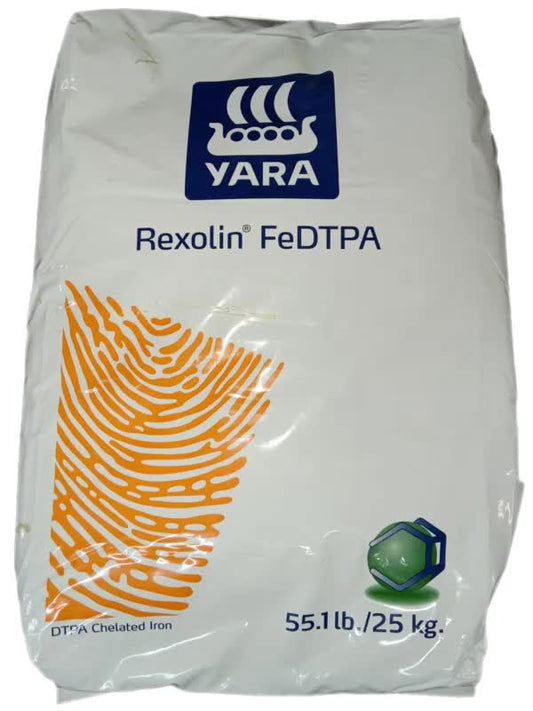
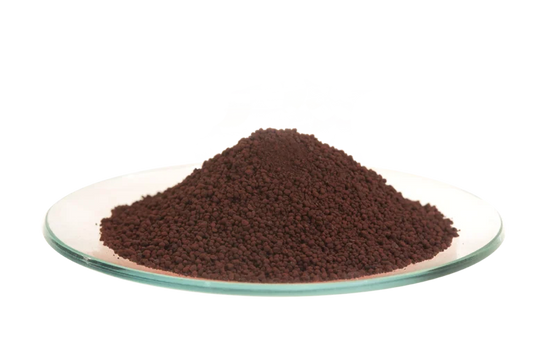
- Fe-DTPA is stable from pH 3.5–7.5 — the preferred form for water culture lettuce.
- Fe-EDDHA or Fe-HBED are ultra-stable alternatives — referenced in the Eurofins A+B tank recipe at 3,723g per 1,000L concentrate, the highest iron load of any crop in the Eurofins dataset.
- Fe-EDTA breaks down above pH 6.0 — avoid in lettuce systems where pH may drift upward.
Chelated Micronutrient Mix provides DTPA/EDTA-chelated trace elements including iron, manganese, zinc, boron, copper, and molybdenum. Add at 0.25–0.5 g per 5 gallons for lettuce — lower rate than fruiting crops given the shorter cycle. For continuous production systems running extended reservoir cycles, increase to 0.5–1.0 g per 5 gallons to compensate for depletion.
Tip Burn: The Calcium Delivery Problem
Tip burn is the most common lettuce quality issue in hydroponic production, and it’s almost never a calcium deficiency in the solution — it’s a calcium delivery failure at the leaf margin. Inner leaves don’t transpire efficiently, so calcium (which moves with water flow) never reaches the growing tip. The Eurofins water culture Ca target of 6 mmol/L (240 ppm) in the root zone with a feed solution of 4.5 mmol/L (180 ppm) reflects the concentration gradient the plant builds.
Solutions:
- Increase air circulation directly over the canopy to drive transpiration
- Keep EC moderate — don’t push above 2.5 mS/cm unless targeting larger heads
- Maintain NH₄ below 0.5 mmol/L (7.0 ppm) — ammoniacal nitrogen competes directly with calcium uptake
- Supplement calcium in RO or soft-water systems with Elite CalMag
System-Specific Notes
DWC (Deep Water Culture): Maintain DO above 7 mg/L — lettuce roots in stagnant, low-oxygen water develop slime and rot quickly. Aeration is as important as nutrition. Large reservoir volume buffers EC and pH swings well.
NFT (Nutrient Film Technique): Thin film flow means the solution contacts roots briefly — keep EC on the lower end (1.2–1.6 mS/cm) to avoid salt accumulation at root tips. Flush channels between cycles. Monitor for pH drift — NFT systems with small reservoir volume are more susceptible.
Raft/Float Systems: Common in commercial lettuce production. Large reservoir volume buffers EC and pH swings. Monitor for nutrient stratification — circulate or aerate to keep solution homogeneous. The Eurofins standard tier (EC 2.5 target / 2.2 mS/cm solution) is well-suited to raft production.
Seasonal and Variety Adjustments
The Eurofins soil data highlights an important principle that applies to water culture as well: winter production requires higher K and NO₃ than summer. Lower light levels reduce photosynthesis and transpiration, slowing nutrient uptake — the solution needs to be slightly more concentrated to compensate. In water culture, increase K by 0.5–1.0 mmol/L (20–39 ppm) and NO₃ by 1–2 mmol/L (14–28 ppm) during low-light winter months.
Variety considerations:
- Butterhead/Bibb: Lower EC tolerance; keep at 1.2–1.6 mS/cm. Most sensitive to tip burn.
- Romaine: Slightly more tolerant; can push to 1.8–2.0 mS/cm at pre-harvest.
- Loose-leaf/Oakleaf: Fast-cycling, very forgiving. Good for dialing in new systems.
- Batavian: Heat-tolerant, slower to bolt — good for warm-season production.
Pre-Harvest Flush
For premium quality, some growers do a 24–48 hour plain water flush before harvest to reduce residual nitrate content in leaf tissue. This improves flavor (less bitter) and is increasingly valued in direct-to-consumer and restaurant markets. Not necessary for all operations, but worth considering if you’re selling into quality-conscious channels.
Solution Testing and Verification
For operations running continuous production or troubleshooting persistent tip burn or quality issues, the Hydroponic Nutrient Solution Lab Test provides a full elemental breakdown — confirming that your mixed solution matches the Eurofins targets above and identifying any imbalances before they affect yield or quality.
Summary
Lettuce nutrition is about restraint and consistency. The MasterBlend 8-15-36 + CalciNit + Epsom Salt foundation gives you the right NPK base. Target EC 2.2–2.6 mS/cm feed solution for water culture, pH 5.3, and keep NH₄ below 0.5 mmol/L (7.0 ppm). Don’t underestimate iron — at 40 µmol/L (2.240 ppm), lettuce has one of the highest Fe demands of any hydroponic crop. Use Fe-DTPA or Fe-EDDHA, keep DO high, and manage air circulation to prevent tip burn. Verify with a lab test when quality issues arise.